Java Reference Objects
Originally published: 2008-06-01
Last updated: 2015-04-27
or
How I Learned to Stop Worrying and Love OutOfMemoryError
Introduction
I started programming with Java in 1999, after fifteen years with C and C++. I thought myself fairly competent at C-style memory management, using coding practices such as pointer handoffs, and tools such as Purify. I couldn't remember the last time I had a memory leak. So it was some measure of disdain that I approached Java's automatic memory management … and quickly fell in love. I hadn't realized just how much mental effort was expended in memory management, until I didn't have to do it any more.
And then I met my first OutOfMemoryError. Just sitting
there on the console, with no accompanying stack trace … because stack
traces require memory! Debugging that error was tough, because the usual
tools just weren't available, not even a malloc logger.
And the state of Java debuggers in 1999 was, to say the least, primitive.
I can't remember what caused that first error, and I certainly didn't resolve it using reference objects. They didn't enter my toolbox until about a year later, when I was writing a server-side database cache and tried using soft references to limit the cache size. Turned out they weren't too useful there, either, for reasons that I'll discuss below. But once reference objects were in my toolbox, I found plenty of other uses for them, and gained a better understanding of the JVM as well.
The Java Heap and Object Life Cycle
For a C++ programmer new to Java, the relationship between stack and heap
can be hard to grasp. In C++, objects may be created on the heap using the
new operator, or on the stack using "automatic" allocation.
The following is legal C++: it creates a new Integer object
on the stack. A Java compiler, however, will reject it as a syntax error.
Integer foo = Integer(1);
Java, unlike C++, stores all objects on the heap, and requires the
new operator to create the object. Local variables are
still stored on the stack, but they hold a pointer to the object, not the object
itself (and of course, to confuse C++ programmers more, these pointers are
called “references”). Consider the following Java method, which
has an Integer variable that references a value parsed
from a String:
public static void foo(String bar)
{
    Integer baz = new Integer(bar);
}
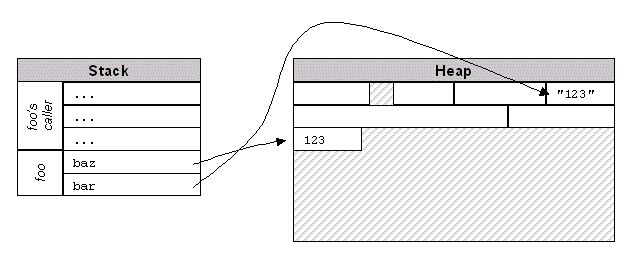
The diagram below shows the relationship between the heap and stack for
this method. The stack is divided into “frames,” which contain
the parameters and local variables for each method in the call tree. Those
variables that point to objects — in this case, the parameter
bar and the local variable baz — point at objects living in the heap.
Now look more closely at the first line of foo(), which
allocates a new Integer object. Behind the scenes, the JVM
first attempts to find enough heap space for this object — approximately
12 bytes on a 32-bit JVM. If able to allocate the space, it then calls the
constructor, which parses the passed string and initializes the newly-allocated
object. Finally, the JVM stores a pointer to that object in the variable
baz.
That's the “happy path.” There are several not-so-happy paths, and
the one that we care about is when the new operator can't
find those 12 bytes for the object. In that case, before giving up and throwing
an OutOfMemoryError, it invokes the garbage collector in
an attempt to make room.
Garbage Collection
While Java gives you a new operator to allocate objects
on the heap, it doesn't give you a corresponding delete operator to remove them. When method foo() returns, the
variable baz goes out of scope but the object it pointed
to still exists on the heap. If this were the end of the story, all programs
would quickly run out of memory. Java, however, provides a garbage collector
to clean up these objects once they're no longer referenced.
The garbage collector goes to work when the program tries to create a new
object and there isn't enough space for it in the heap. The requesting
thread is suspended while the collector looks through the heap, trying to
find objects that are no longer actively used by the program, and
reclaiming their space. If the collector is unable to free up enough space,
and the JVM is unable to expand the heap, the new operator
fails with an OutOfMemoryError. This is normally followed
by your application shutting down.
Mark-Sweep
One of the enduring myths of Java revolves around the garbage collector. Many people believe that the JVM keeps a reference count for each object, and the collector only looks at objects whose reference count is zero. In reality, the JVM uses a technique known as “mark-sweep.” The idea behind mark-sweep garbage collection is simple: every object that can't be reached by the program is garbage, and is eligible for collection.
Mark-sweep collection has the following phases:
|
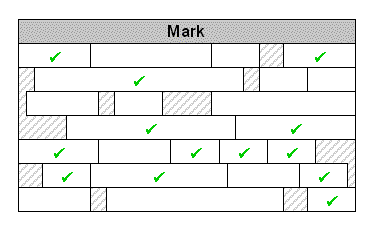
Phase 1: Mark
The garbage collector starts from “root” references, and walks through the object graph marking all objects that it reaches. |
 |
|
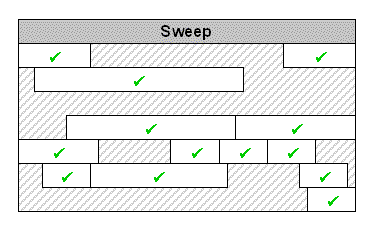
Phase 2: Sweep
Anything that hasn't been marked in the first phase is unreachable, and therefore, garbage. If a garbage object has a finalizer defined, it's added to the finalization queue (more about that later). If not, its space is made available for re-allocation (exactly what that means depends on the specific GC implementation, and there are many implementations). |
 |
|
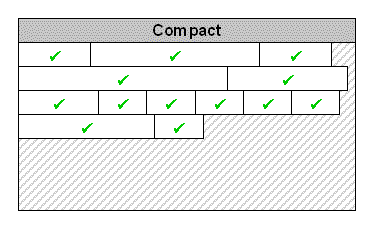
Phase 3: Compact (optional)
Some collectors have a third step: compaction. In this step, the GC moves objects to coalesce free space left behind by the collected garbage. This prevents the heap from becoming fragmented, which can cause large contiguous allocations to fail. The Hotspot JVM, for example, uses a compacting collector for its “young” generation, but a non-compacting collector (at least in the 1.6 and 1.7 “server” JVMs) for its ”tenured” generations. For more information, see the references at the end of this article. |
 |
So what are the "roots"? In a simple Java application, they're method arguments and local variables (stored on the stack), the operands of the currently executing expression (also stored on the stack), and static class member variables.
In programs that use their own classloaders, such as app-servers, the picture gets muddy: only classes loaded by the system classloader (the loader used by the JVM when it starts) contain root references. Any classloaders that the application creates are themselves subject to collection, once there are no more references to them. This is what allows app-servers to hot-deploy: they create a separate classloader for each deployed application, and let go of the classloader reference when the application is undeployed or redeployed.
It's important to understand root references, because they define what a "strong" reference is: if you can follow a chain of references from a root to a particular object, then that object is "strongly" referenced. It will not be collected.
So, returning to method foo(), the parameter
bar and local variable baz are
strong references only while the method is executing. Once it finishes, they
both go out of scope, and the objects they referenced are eligible for
collection. Alternatively, foo() might return a reference
to the Integer that it creates, meaning that object would
remain strongly referenced by the method that called foo().
Now consider the following:
LinkedList foo = new LinkedList();
foo.add(new Integer(123));
Variable foo is a root reference, which points to the
LinkedList object. Inside the linked list are zero or
more list elements, each of which points to its successor. When we call
add(), we add a new list element, and that list element
points to an Integer instance with the value 123. This
is a chain of strong references, meaning that the Integer is not eligible for collection. As soon as foo goes out
of scope, however, the LinkedList and everything in it
are eligible for collection — provided, of course, that there are no
other strong references to it.
You may be wondering what happens if you have a circular reference: object A contains a reference to object B, which contains a reference back to A. The answer is that a mark-sweep collector isn't fooled: if neither A nor B can be reached by a chain of strong references, then they're eligible for collection.
Finalizers
C++ allows objects to define a destructor method: when the object goes out
of scope or is explicitly deleted, its destructor is called to clean up the
resources it used. For most objects, this means explicitly releasing any
memory that the object allocated with new or
malloc. In Java, the garbage collector handles memory
cleanup for you, so there's no need for an explicit destructor to do this.
However, memory isn't the only resource that might need to be cleaned up.
Consider FileOutputStream: when you create an instance
of this object, it allocates a file handle from the operating system. If you
let all references to the stream go out of scope before closing it, what
happens to that file handle? The answer is that the stream has a
finalizer method: a method that's called by the JVM just before
the garbage collector reclaims the object. In the case of
FileOutputStream, the finalizer closes the stream, which
releases the file handle back to the operating system — and also
flushes any buffers, ensuring that all data is properly written to disk.
Any object can have a finalizer; all you have to do is declare the
finalize() method:
protected void finalize() throws Throwable
{
    // cleanup your object here
}
While finalizers seem like an easy way to clean up after yourself, they do have some serious limitations. First, you should never rely on them for anything important, since an object's finalizer may never be called — the application might exit before the object is eligible for garbage collection. There are some other, more subtle problems with finalizers, but I'll hold off on these until we get to phantom references.
Object Life Cycle (without Reference Objects)
Putting it all together, an object's life can be summed up by the simple
picture below: it's created, it's used, it becomes eligible for collection,
and eventually it's collected. The shaded area represents the time during
which the object is "strongly reachable," a term that becomes important by
comparison with the reachability provided by reference objects.

Enter Reference Objects
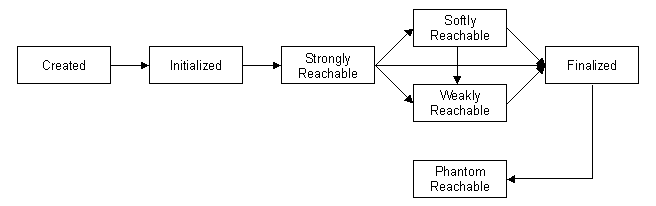
JDK 1.2 introduced the java.lang.ref package, and three new stages in the object life cycle: softly-reachable,
weakly-reachable, and phantom-reachable. These states only apply to objects
eligible for collection — in other words, those with no strong
references — and the object in question must be the referent
of a reference object:
- softly reachable
- The object is the referent of a
SoftReference, and there are no strong references to it. The garbage collector will attempt to preserve the object as long as possible, but will collect it before throwing anOutOfMemoryError. - weakly reachable
- The object is the referent of a
WeakReference, and there are no strong or soft references to it. The garbage collector is free to collect the object at any time, with no attempt to preserve it. In practice, the object will be collected during a major collection, but may survive a minor collection. - phantom reachable
- The object is the referent of a
PhantomReference, and it has already been selected for collection and its finalizer (if any) has run. The term “reachable” is really a misnomer in this case, as there's no way for you to access the actual object.
As you might guess, adding three new optional states to the object
life-cycle diagram makes for a mess. Although the documentation indicates a
logical progression from strongly reachable through soft, weak, and phantom,
to reclaimed, the actual progression depends on what reference objects your
program creates. If you create a WeakReference but
don't create a SoftReference, then an object progresses
directly from strongly-reachable to weakly-reachable to finalized to
collected.
It's also important to understand that not all objects are attached to reference objects — in fact, very few of them should be. A reference object is a layer of indirection: you go through the reference object to reach the referent, and clearly you don't want that layer of indirection throughout your code. Most programs, in fact, will use reference objects to access a relatively small number of the objects that the program creates.
References and Referents
A reference object is a layer of indirection between your program code
and some other object, called a referent. Each reference object
is constructed around its referent, and the referent cannot be changed.

The reference object provides the get() method to retrieve
a strong reference to its referent. The garbage collector may reclaim the
referent at any point; once this happens, get() returns
null. To use references properly, you need code like the
following:
SoftReference<List<Foo>> ref = new SoftReference<List<Foo>>(new LinkedList<Foo>());

// somewhere else in your code, you create a Foo that you want to add to the list
List<Foo> list = ref.get();
if (list != null)
{
    list.add(foo);
}
else
{
    // list is gone; do whatever is appropriate
}
Or in words:
- You must always check to see if the referent is
null
The garbage collector can clear the reference at any time, and if you blithely use the reference, sooner or later you'll get aNullPointerException. - You must hold a strong reference to the referent to use it
Again, the garbage collector can clear the reference at any time, even in the middle of a single expression. If, rather than creating thelistvariable, I simply callref.get().add(foo), the reference might be cleared between the check for null and actual use. Always remember that the garbage collector runs in its own thread, and doesn't care what your code is doing. - You must hold a strong reference to the reference object
If you create a reference object, but allow it to go out of scope, then the reference object itself will be garbage-collected. Seems obvious, but it's easy to forget, especially when you're using reference queues (qv) to track your references.
Also remember that soft, weak, and phantom references only come into play when there are no more strong references to the referent. They exist to let you hold onto objects past the point where they'd normally become food for the garbage collector. This may seem like a strange thing — if you no longer hold a strong reference, why would you care about the object? The reason depends on the specific reference type.
Soft References
We'll start to answer that question with soft references. If an object is
the referent of a SoftReference and there are no strong
references to it, then the garbage collector is free to reclaim the object
but tries not to. As a result, a softly-referenced object may survive
garbage collection — even several cycles of garbage collection —
as long as the JVM is able to recover “enough” memory without
clearing it.
The JDK documentation says that soft references are appropriate for a
memory-sensitive cache: each of the cached objects is accessed through a
SoftReference, and if the JVM decides that it needs
space, then it will clear some or all of the references and reclaim their
referents. If it doesn't need space, then the referents remain in the heap
and can be accessed be program code. In this scenario, the referents are
strongly referenced when they're being actively used, softly referenced
otherwise. If a soft reference gets cleared, you need to refresh the cache.
To be useful in this role, however, the cached objects need to be pretty large — on the order of several kilobytes each. Useful, perhaps, if you're implementing a fileserver that expects the same files to be retrieved on a regular basis, or have large object graphs that need to be cached. But if your objects are small, then you'll have to clear a lot of them to make a difference, and the reference objects will add overhead to the whole process.
Soft Reference as Circuit Breaker
A better use of soft references is to provide a "circuit breaker" for
memory allocation: put a soft reference between your code and the memory it
allocates, and you avoid the dreaded OutOfMemoryError.
This technique works because memory allocation tends to be localized within the
application: reading rows from a database, or processing data from a file.
For example, if you write a lot of JDBC code, you might have a method like
the following to process query results in a generic way and ensure that the
ResultSet is properly closed. It only has one small flaw:
what happens if the query returns a million rows and you don't have available
memory to store them?
public static List<List<Object>> processResults(ResultSet rslt)
throws SQLException
{
    try
    {
        List<List<Object>> results = new LinkedList<List<Object>>();
        ResultSetMetaData meta = rslt.getMetaData();
        int colCount = meta.getColumnCount();

        while (rslt.next())
        {
            List<Object> row = new ArrayList<Object>(colCount);
            for (int ii = 1 ; ii <= colCount ; ii++)
                row.add(rslt.getObject(ii));

            results.add(row);
        }

        return results;
    }
    finally
    {
        closeQuietly(rslt);
    }
}
The answer, of course, is an OutOfMemoryError. Which
makes this the perfect place for a circuit breaker: if the JVM runs out of
memory while processing the query, release all the memory that it's
already used, and throw an application-specific exception.
At this point, you may wonder: who cares? The query is going to abort in either case, why not just let the out-of-memory error do the job? The answer is that your application may not be the only thing affected. If you're running on an application server, your memory usage could take down other applications. Even in an unshared environment, a circuit-breaker improves the robustness of your application, because it confines the problem and gives you a chance to recover and continue.
To create the circuit breaker, the first thing you need to do is wrap the
results list in a SoftReference (you've seen this code
before):
    SoftReference<List<List<Object>>> ref
        = new SoftReference<List<List<Object>>>(new LinkedList<List<Object>>());
And then, as you iterate through the results, create a strong reference to the list only when you need to update it:
while (rslt.next())
{
    rowCount++;
    // store the row data

    List<List<Object>> results = ref.get();
    if (results == null)
        throw new TooManyResultsException(rowCount);
    else
        results.add(row);

    results = null;
}
This works because almost all of the method's memory allocation happens in
two places: the call to next(), and the code that stores
the row's data in its own list. In the first case, there's a lot that happens
when you call next(): the ResultSet typically retrieves a large block of binary data, containing multiple rows. Then,
when you call getObject(), it extracts a piece of that data
and wraps it in a Java object.
While those expensive operations happen, the only reference to the list is via
the SoftReference. If you run out of memory the reference
will be cleared, and the list will become garbage. It means that the method
throws, but the effect of that throw can be confined. And perhaps the calling
code can recreate the query with a retrieval limit.
Once the expensive operations complete, you can hold a strong reference to the
list with relative impunity. However, note that I use a LinkedList for my results rather than an ArrayList: I know that linked lists
grow in increments of a few dozen bytes, which is unlikely to trigger
OutOfMemoryError. By comparison, if an
ArrayList needs to increase its capacity, it must create a
new array to do so. In a large list, this could mean a multi-megabyte allocation.
Also note that I set the results variable to
null after adding the new element; this is one of the few cases
where doing so is justified. Although the variable goes out of scope at the end of the
loop, the garbage collector might not know that (because there's no reason for the JVM
to clear the variable's slot in the call stack). So, if I didn't clear the
variable, it would be an unintended strong reference during the subsequent
pass through the loop.
Soft References Aren't A Silver Bullet
While soft references can prevent many out-of-memory conditions, they can't prevent all of them. The problem is this: in order to actually use a soft reference, you have to create a strong reference to the referent: to add a row to the results, we need to have a reference to the actual list. During the time we hold that string reference, we are at risk for an out-of-memory error.
The goal with a circuit breaker is to minimize the window during which it's
useless: the time that you hold a strong reference to the object, and
perhaps more important, the amount of allocation that happens during this
time. In our case, we confine the strong reference to adding a row to the
results, and we use a LinkedList rather than an
ArrayList because the former grows in much smaller
increments.
And I want to repeat that, while I hold the strong reference in a variable
that quickly goes out of scope, the language spec says nothing about the JVM
being required to clear variables that go out of scope. And as-of this writing,
the Oracle/OpenJDK JVM does not do so. If I didn't explicitly clear the
results variable, it would remain a strong reference
throughout the loop, acting like a penny in a fuse box, and preventing the
soft reference from doing its job.
Finally, think carefully about non-obvious strong references. For example, you might want to add a circuit breaker while constructing XML documents using the DOM. However, each node in a DOM holds a reference to its parent, in effect holding a reference to every other node in the tree. And if you use a recursive call to build that document, your stack might be full of references to individual nodes.
Weak References
A weak reference, as its name suggests, is a reference object that doesn't put up a fight when the garbage collector comes knocking. If there are no strong or soft references to the referent, it's all but guaranteed to be collected. So what's the use? There are in fact two main uses: associating objects that have no inherent relationship, and reducing duplication via a canonicalizing map.
The Problem With ObjectOutputStream
As an example of the first case, I'm going to look at object serialization,
which doesn't use weak references.
ObjectOutputStream and its partner
ObjectInputStream provide a way to
transform arbitrary Java object graphs into a stream of bytes and back again.
From the perspective of object modeling, there is no relationship between the
streams and the objects written using those streams: the stream is not
composed of the objects that are written, nor does it aggregate them.
But when you look at the stream specification, you see that there is in fact a relationship: in order to preserve object identity, the output stream associates a unique identifier with each object written, and subsequent requests to write the object instead write the identifier. This feature is absolutely critical to the stream's ability to serialize arbitrary object graphs: if it wasn't present, a self-referential graph would turn into an infinite stream of bytes.
To implement this feature, both streams need to maintain a strong reference
to every object written to the stream. For the programmer who decides to
use object streams as an easy way to layer a messaging protocol onto a
socket connection, this is a problem: messages are assumed transient, but
the streams hold them in memory. Sooner or later, the program runs out of
memory (unless the programmer knows to call reset() after every message).
Such non-inherent relationships are surprisingly common: they exist whenever
the programmer needs to maintain context essential for the use of an object.
Sometimes, as in the case of a servlet Session object,
these associations are managed implicitly by the environment. Sometimes, as
in the case of object streams, the associations must be managed explicitly by
the programmer. And other times, as in the case of a static Map buried deep within the application code, the associations are only discovered
when the production server throws an out-of-memory error.
Weak references provide a way to maintain such associations while letting the garbage collector do its work: the weak reference remains valid only as long as there are also strong references. Returning to the object stream example, if you're using the stream for messaging, the message will be eligible for collection as soon as it's written. On the other hand, a stream used for RMI access to a long-lived data structure would maintain its sense of identity.
Unfortunately, although the object stream protocol was updated with the 1.2
JDK, and weak references were added at the same time, the JDK developers didn't
choose to combine them. So remember to call reset().
Eliminating Duplicate Data with Canonicalizing Maps
Object streams notwithstanding, I don't believe there are many cases where you should associate two objects that don't have an inherent relationship. And some of the examples that I've seen, such as Swing listeners that clean up after themselves, seem more like hacks than valid design choices.
In my opinion, the best use of weak references is to implement a canonicalizing
map, a mechanism to ensure that only one instance of a value object exists at
a time. String.intern() is the classic example of such a map:
when
you intern a string the JVM adds it to a special map that's also used to hold
string literals. The reason to do this is not, as some people think,
in order to make comparisons faster. It's to minimize the amount of memory
consumed by duplicated non-literal strings (such as those read from a file
or message queue).
A simple canonicalizing map works by using the same object as key and value:
you probe the map with an arbitrary instance, and if there's already a value
in the map, you return it. If there's no value in the map, you store the
instance that was passed in (and return it). Of course, this only works for
objects that can be used as map keys. Here's how we might implement
String.intern() if we weren't worried about memory leaks:
private Map<String,String> _map = new HashMap<String,String>();

public synchronized String intern(String str)
{
    if (_map.containsKey(str))
        return _map.get(str);
    _map.put(str, str);
    return str;
}
This implementation is fine if you have a small number of strings to intern, perhaps within a single method that processes a file. However, let's say that you're writing a long-running application that has to process input from multiple sources, that contain a wide range of strings but still has a high level of duplication. For example, a server that processes uploaded files of postal address data: there will be lots of entries for New York City, not so many for Temperanceville VA. You would want to eliminate duplication of the former, but not hold onto the latter any longer than necessary.
This is where a canonicalizing map with weak reference helps: it allows you to create a canonical instance only so long as some code in the program is using it. After the last strong reference disappears, the canonical string will be collected. If the string is seen again later, it becomes the new canonical instance.
To improve our canonicalizer, we can replace HashMap with a WeakHashMap:
private Map<String,WeakReference<String>> _map
    = new WeakHashMap<String,WeakReference<String>>();

public synchronized String intern(String str)
{
    WeakReference<String> ref = _map.get(str);
    String s2 = (ref != null) ? ref.get() : null;
    if (s2 != null)
        return s2;

    _map.put(str, new WeakReference(str));
    return str;
}
First thing to notice is that, while the map's key is a String,
its value is a WeakReference<String>. This is because
WeakHashMap uses weak references for its keys, but
holds strong references to its values. Since our key and value are the same,
the entry would never get collected. By wrapping the entry, we let the GC
collect it.
Second, note the process for returning a string: first we retrieve the weak reference. If it exists, then we retrieve the referent. But we have to check that object as well. It's possible that the reference is sitting in the map but is already cleared. Only if the referent is not null do we return it; otherwise we consider the passed-in string to be the new canonical version.
Thirdly, note that I've synchronized the intern() method.
The most likely use for a canonicalizing map is in a multi-threaded environment
such as an app-server, and WeakhashMap isn't synchronized
internally. The synchronization in this example is actually rather naive,
and the intern() method can become a point of contention.
In a real-world implementation, I might use ConcurrentHashMap,
but the naive approach works better for a tutorial.
Finally, the documentation for WeakHashMap is somewhat
vague about when entries get removed from the map. It states that “a
WeakHashMap may behave as though an unknown thread is
silently removing entries.” In reality there is no other thread. Instead,
the map cleans up whenever it's accessed. To keep track of which entries are no
longer valid, it uses a reference queue.
Reference Queues
While testing a reference for null lets you know whether
its referent has been collected, doing so isn't very efficient &mash; if you
have a lot of references, your program will spend most of its time looking
for those that have been cleared.
The better solution is a reference queue: you associate a reference with a
queue at construction time, and the reference will be put on the queue after
it has been cleared. To discover which references have been cleared, you
poll the queue. This can be done with a background thread, but it's often
simpler to poll the queue at the time you create new references (this is what
WeakHashMap does).
Reference queues are most often used with phantom references, described
below, but can be used with any reference type. The following code is an
example with weak references: it creates a bunch of buffers, accessed via a
WeakReference, and after every creation looks to see what
references have been cleared. If you run this code, you'll see long runs of
create messages, interspersed with an occasional run of clear messages when
the garbage collector runs.
public static void main(String[] argv) throws Exception
{
    Set<WeakReference<byte[]>> refs = new HashSet<WeakReference<byte[]>>();
    ReferenceQueue<byte[]> queue = new ReferenceQueue<byte[]>();

    for (int ii = 0 ; ii < 1000 ; ii++)
    {
        WeakReference<byte[]> ref = new WeakReference<byte[]>(new byte[1000000], queue);
        System.err.println(ii + ": created " + ref);
        refs.add(ref);

        Reference<? extends byte[]> r2;
        while ((r2 = queue.poll()) != null)
        {
            System.err.println("cleared " + r2);
            refs.remove(r2);
        }
    }
}
As always, there are things to note about this code. First, although we're
creating WeakReference instances, polling the queue gives
us a plain Reference. This serves to remind you that, once
they're enqueued, it no longer matters what type of a reference you're using; the
referent has already been cleared.
Second is that we must hold a strong reference to the reference objects
themselves. The reference object knows about the queue, but the queue
doesn't know about the reference until it's enqueued. If we didn't maintain
the strong reference to the reference object, it would itself be collected,
and never added to the queue. I use a Set in this example,
and remove the references once they've been cleared (leaving them in the set is
a memory leak).
Phantom References
Phantom references differ from soft and weak references in that they're not used to access their referents. Instead, their sole purpose is to tell you when their referent has already been collected. While this seems rather pointless, it actually allows you to perform resource cleanup with more flexibility than you get from finalizers.
The Trouble With Finalizers
Back in the description of object life cycle, I mentioned that finalizers have subtle problems that make them unsuitable for cleaning up non-memory resources. There are also a couple of non-subtle problems, that I'll cover here for completeness and then promptly ignore.
- A finalizer might never be invoked
If your program never runs out of available memory, then the garbage collector won't run, and neither will your finalizers. This usually isn't an issue with long-running (eg, server) applications, but short-running programs may finish without ever running garbage collection. And while there is a way to tell the JVM to run finalizers before the program exits, this is unreliable and may conflict with other shutdown hooks. - Finalizers can create another strong reference to an object
For example, by adding the object to a collection. This essentially resurrects the object, but, as with Stephen King's Pet Sematary, the returned object “isn't quite right.” In particular, its finalizer won't run when the object is again eligible for collection. Perhaps there's a reason that you would use this resurrection trick, but I can't imagine it, and would look very dimly on code that did.
Now that those are out of the way, I believe the real problem with finalizers
is that they introduce a gap between the time that the garbage collector first
identifies an object for collection and the time that its memory is actually
reclaimed, because finalization happens on its own thread, independent of the
garbage collector's thread. The JVM is guaranteed to perform a full collection
before it returns OutOfMemoryError, but if all objects
eligible for collection have finalizers, then the collection will have no effect:
those objects remain in memory awaiting finalization. Throw in the fact that
a standard JVM only has a single thread to handle finalization for all objects,
and some long-running finalizers, and you can see where issues might arise.
The following program demonstrates this behavior: each object has a finalizer
that sleeps for half a second. Not much time at all, unless you've got thousands
of objects to clean up. Every object goes out of scope immediately after it's
created, yet at some point you'll run out of memory (if you want to run this
example, I recommend using -Xmx64m to make the error happen
quickly; on my development machine, with a 3 Gb heap, it literally takes
minutes to fail).
public class SlowFinalizer
{
    public static void main(String[] argv) throws Exception
    {
        while (true)
        {
            Object foo = new SlowFinalizer();
        }
    }

    // some member variables to take up space -- approx 200 bytes
    double a,b,c,d,e,f,g,h,i,j,k,l,m,n,o,p,q,r,s,t,u,v,w,x,y,z;

    // and the finalizer, which does nothing by take time
    protected void finalize() throws Throwable
    {
        try { Thread.sleep(500L); }
        catch (InterruptedException ignored) {}
        super.finalize();
    }
}
The Phantom Knows
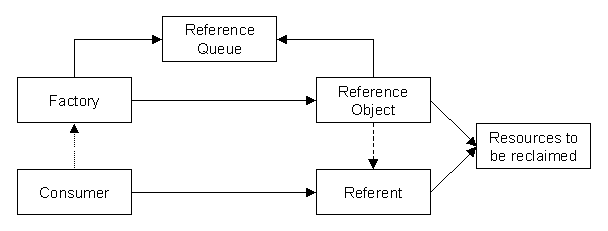
Phantom references allow the application to learn when an object is no longer used, so that the application can clean up the object's non-memory resources. Unlike finalizers, however, the object itself has already been collected by the time the application learns this.
Also unlike finalizers, cleanup is scheduled by the application, not the garbage collector. You might dedicate one or more threads to cleanup, perhaps increasing the number if the number of objects demands it. An alternative — and often simpler — approach is to use an object factory, and clean up after any collected instances before creating a new one.
The key point to understand about phantom references is that you can't
use the reference to access the object: get() always
returns null, even if the object is still strongly reachable.
This means that the referent can't hold the sole reference to the resources
to be cleaned up. Instead, you must maintain at least one other strong reference
to those resources, and use a reference queue to signal that the referent has
been collected. As with the other reference types, your program must also hold
a strong reference to the reference object itself, or it will be collected and
the resources leaked.
Implementing a Connection Pool with Phantom References
Database connections are one of the most precious resources in any
application: they take time to establish, and database servers place strict
limits on the number of simultaneous open connections that they'll accept.
For all that, programmers are remarkably careless with them, sometimes
opening a new connection for every query and either forgetting to close it
or not closing it in a finally block.
Rather than allow the application to open direct connections to the database, most application server deployments use a connection pool: the pool maintains a (normally fixed) set of open connections, and hands them to the program as needed. Production-quality pools provide several ways to prevent connection leaks, including timeouts (to identify queries that run excessively long) and recovery of connections that are left for the garbage collector.
This latter feature serves as a great example of phantom references. To make
it work, the Connection objects that the pool provides are
just wrappers around an actual database connection. They can be collected without
losing the database connection because the pool maintains its own strong
reference to the actual connection. The pool associates a phantom reference
with the “wrapper” connection, and return the actual connection
to the pool if and when that reference ends up on a reference queue.
The least interesting part of the pool is the PooledConnection,
shown below. As I said, it's a wrapper that delegates calls to the actual
connection. One twist is that I used a reflection proxy for implementation. The JDBC interface has evolved with
each version of Java, in ways that are neither forward nor backward compatible;
if I had used a concrete implementation, you wouldn't be able to compile the
demo unless you used the same JDK version that I did. The reflection proxy
solves this problem, and also makes the code quite a bit shorter.
public class PooledConnection
implements InvocationHandler
{
    private ConnectionPool _pool;
    private Connection _cxt;

    public PooledConnection(ConnectionPool pool, Connection cxt)
    {
        _pool = pool;
        _cxt = cxt;
    }

    private Connection getConnection()
    {
        try
        {
            if ((_cxt == null) || _cxt.isClosed())
                throw new RuntimeException("Connection is closed");
        }
        catch (SQLException ex)
        {
            throw new RuntimeException("unable to determine if underlying connection is open", ex);
        }

        return _cxt;
    }

    public static Connection newInstance(ConnectionPool pool, Connection cxt)
    {
        return (Connection)Proxy.newProxyInstance(
                   PooledConnection.class.getClassLoader(),
                   new Class[] { Connection.class },
                   new PooledConnection(pool, cxt));
    }

    @Override
    public Object invoke(Object proxy, Method method, Object[] args)
    throws Throwable
    {
        // if calling close() or isClosed(), invoke our implementation
        // otherwise, invoke the passed method on the delegate
    }

    private void close() throws SQLException
    {
        if (_cxt != null)
        {
            _pool.releaseConnection(_cxt);
            _cxt = null;
        }
    }

    private boolean isClosed() throws SQLException
    {
        return (_cxt == null) || (_cxt.isClosed());
    }
}
The most important thing to note is that PooledConnection has
a reference to both the underlying database connection and the pool. The latter
is used for applications that do remember to close the connection: we want to
tell the pool right away, so that the underlying connection can be immediately
reused.
The getConnection() method also deserves some mention: it
exists to catch applications that attempt to use a connection after they've
explicitly closed it. This could be a very bad thing if the connection has already
been handed to another consumer. So close() explicitly clears
the reference, and getConnection() checks this and throws if
the connection is no longer valid. The invocation handler uses this method for
all delegated calls.
So now let's turn our attention to the pool itself, starting with the objects it uses to manage connections.
private Queue<Connection> _pool = new LinkedList<Connection>();

private ReferenceQueue<Object> _refQueue = new ReferenceQueue<Object>();

private IdentityHashMap<Object,Connection> _ref2Cxt = new IdentityHashMap<Object,Connection>();
private IdentityHashMap<Connection,Object> _cxt2Ref = new IdentityHashMap<Connection,Object>();
Available connections are initialized when the pool is constructed and stored in
_pool. We use a reference queue, _refQueue,
to identify connections have been collected. And finally, we have a bidirectional
mapping between connections and references, used when returning connections to
the pool.
As I've said before, the actual database connection will be wrapped in a
PooledConnection before it is handed to application code.
This happens in the wrapConnection() function, which is
also where we create the phantom reference and the connection-reference mappings.
private synchronized Connection wrapConnection(Connection cxt)
{
    Connection wrapped = PooledConnection.newInstance(this, cxt);
    PhantomReference<Connection> ref = new PhantomReference<Connection>(wrapped, _refQueue);
    _cxt2Ref.put(cxt, ref);
    _ref2Cxt.put(ref, cxt);
    System.err.println("Acquired connection " + cxt );
    return wrapped;
}
The counterpart of wrapConnection is
releaseConnection(),
and there are two variants of this function. The first is called by
PooledConnection when the application code explicitly
closes the connection. This is the “happy path, ” and it puts the
connection back into the pool for later use. It also clears the mappings between
connection and reference, as they're no longer needed. Note that this method has
default (package) synchronization: it's called by PooledConnection so can't be private, but is not generally accessible.
synchronized void releaseConnection(Connection cxt)
{
    Object ref = _cxt2Ref.remove(cxt);
    _ref2Cxt.remove(ref);
    _pool.offer(cxt);
    System.err.println("Released connection " + cxt);
}
The other variant is called using the phantom reference; it's the “sad path,” followed when the application doesn't remember to close the connection. In this case, all we've got is the phantom reference, and we need to use the mapping to retrieve the actual connection (which is then returned to the pool using the first variant). .
private synchronized void releaseConnection(Reference<?> ref)
{
    Connection cxt = _ref2Cxt.remove(ref);
    if (cxt != null)
        releaseConnection(cxt);
}
There is one edge case: what happens if the reference gets enqueued after the
application has called close()? This case is unlikely:
when we cleared the mapping, the phantom reference should have become eligible
for collection, so it wouldn't be enqueued. However, we have to consider this
case, which results in the null check above: if the mapping has already been
removed, then the connection has been explicitly returned and we don't need
to do anything.
OK, you've seen the low-level code, now it's time for the only method that the application will call:
public Connection getConnection()
throws SQLException
{
    while (true)
    {
        synchronized (this)
        {
            if (_pool.size() > 0)
                return wrapConnection(_pool.remove());
        }

        tryWaitingForGarbageCollector();
    }
}
The happy path for getConnection() that there are connections
available in _pool. In this case one is removed, wrapped, and
returned to the caller. The sad path is that there aren't any connections,
in which case the caller expects us to block until until one becomes available.
This can happen two ways: either the application closes a connection and it goes
back in _pool, or the garbage collector finds one that's
been abandoned, and enqueues its associated phantom reference.
Before following that path, I want to talk about synchronization. Clearly,
all access to the internal data structures must be synchronized, because
multiple threads may attempt to get or return connections concurrently. As
long as there are connections in _pool, the synchronized
code executes quickly and the chance of contention is low. However, if we
have to loop until connections become available, we want to minimize the
amount of time that we're synchronized: we don't want to cause a deadlock
between a caller requesting a connection and another caller returning one.
Thus the explicit synchronized block while checking for
connections.
So, what happens if we call getConnection() and the pool
is empty? This is when we examine the reference queue to find an abandoned
connection.
private void tryWaitingForGarbageCollector()
{
    try
    {
        Reference<?> ref = _refQueue.remove(100);
        if (ref != null)
            releaseConnection(ref);
    }
    catch (InterruptedException ignored)
    {
        // we have to catch this exception, but it provides no information here
        // a production-quality pool might use it as part of an orderly shutdown
    }
}
This function highlights another set of conflicting goals: we don't want to
waste time if there aren't any enqueued references, but we also don't want
to spin in a tight loop in which we repeatedly check _pool and _refQueue. So I use a short timeout when polling the
queue: if there's nothing ready, it gives another thread the chance to return a
connection. This does, of course, introduce a fairness problem: while one
thread is waiting on the reference queue, another might return a connection
that's immediately grabbed by a third. In theory, the waiting thread could
be waiting forever. In the real world, with infrequent need for database
connections, this situation is unlikely to happen.
The Trouble with Phantom References
Several pages back, I noted that finalizers are not guaranteed to be called.
Neither are phantom references, and for the same reasons: if the collector
doesn't run, unreachable objects aren't collected, and references to those
objects won't be enqueued. Consider a program did nothing but call
getConnection() in a loop and let the returned connections
go out of scope. If it did nothing else to make the garbage collector run, then
it would quickly exhaust the pool and block, waiting for a connection that
will never be recovered.
There are, of course, ways to resolve this problem. One of the simplest is to
call System.gc() in tryWaitingForGarbageCollector().
While there is a lot of myth and dogma surrounding this method — the use
of the word “suggests” in its documentation has been grist for
amateur language lawyers as long as I can remember — it's an effective
way to nudge the JVM back toward a desired state. And it's a technique that
works for finalizers as well as phantom references.
That doesn't mean that you should ignore phantom references and just use a finalizer. In the case of a connection pool, for example, you might want to explicitly shut down the pool and close all of the underlying connections. You could do that with finalizers, but would need just as much bookkeeping as with phantom references. In that case, the additional control that you get with references (versus an arbitrary finalization thread) makes them a better choice.
A Final Thought: Sometimes You Just Need More Memory
While reference objects are a tremendously useful tool to manage your memory consumption, sometimes they're not sufficient and sometimes they're overkill. For example, let's say that you're building a large object graph, containing data that you read from the database. While you could use soft references as a circuit breaker for the read, and weak references to canonicalize that data, ultimately your program requires a certain amount of memory to run. If you can't give it enough to actually accomplish any work, it doesn't matter how robust your error recovery is.
Your first response to OutOfMemoryError should be to
figure out why it's happening.
Maybe you have a leak, maybe your memory settings are simply too low.
During development, you should specify a large heap size — 1 Gb or
more if you have the physical memory - and pay careful attention to how much
memory is actually used (jconsole is a useful tool here).
Most applications will reach a steady state under simulated load, and that should
guide your production heap settings . If your memory usage climbs over time,
it's quite probable that you are holding strong references to objects after
they're no longer in use. Reference objects may help here, but it's more
likely that you've got a bug that should be fixed.
The bottom line is that you need to understand your applications. A canonicalizing map won't help you if you don't have duplication. Soft references won't help if you expect to execute multi-million row queries on a regular basis. But in the situations where they can be used, reference objects are often life savers.
Additional Information
You can download the sample programs for this article:
- CircuitBreakerDemo uses a simulated database result-set to trip a memory-driven circuit breaker.
- WeakCanonicalizingMap uses a
WeakHashMapto create canonical strings. The demo program is perhaps more interesting: it shows the extreme lengths that one has to go to trigger garbage collection (note: running with a large heap is unlikely to work, try using-Xmx100m). - SlowFinalizer show how you can run out of memory even if the garbage collector runs.
- ConnectionPool and PooledConnection implement a very simple connection pool; ConnectionPoolDemo exercises this pool using an in-memory HSQLDB database (here's the Maven POM needed to build this and the other examples).
The “string canonicalizer” class is available from SourceForge, licensed under Apache 2.0.
Sun has many articles on tuning their JVM's memory management. This article is an excellent introduction, and provides links to additional documentation.
Brian Goetz has a great column on the IBM developerWorks site, "Java Theory
and Practice." A few years ago, he wrote columns on using both
soft and
weak references. These articles go into depth on some of the topics that I simply
skimmed over, such as using WeakHashMap to associate objects
with different lifetimes.
Copyright © Keith D Gregory, all rights reserved