A Year With Tabitha
Originally published: 2025-12-01
Last updated: 2025-12-01
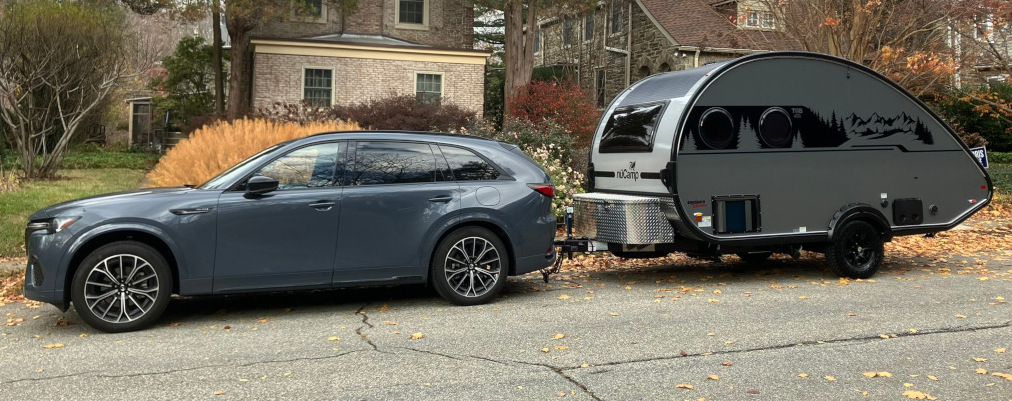
Tabitha is our 2025 nuCamp T@B 400 travel trailer. We brought her home on Black Friday, November 29 2024, and took her on her first trip that weekend. This is the story of our past year with her, as travel-trailer newbies.
Background
We rented a motorhome in 2020, allowing us to vacation at the height of the pandemic. That was a fun experience, but I learned that I didn't want a motorhome. Leaving the campsite to explore the area involved a lot of packing, and its 26 foot length made parking a challenge. Plus, motorhomes are really expensive, even used, and have lots of systems that can break down and require expensive repairs.
So, if we bought an RV, it would be a towable. But our Subaru Outback had a 2,700 pound towing capacity, which limited our options. And one of the things that I really liked about the motorhome was that it had an onboard bathroom, meaning no midnight walks to a campground bathhouse.
The post-pandemic supply chain issues kept me away from automotive dealerships, and I didn't want a truck anyway. But I continued to go to the Hershey RV show, and became more and more enamored of the teardrop-style trailers produced by nuCamp and Little Guy. And as 2024 rolled around, the Outback was due for replacement.
Towing capacity was high on our list of criteria for the new vehicle: at least 5,000 pounds. I wasn't planning to buy a trailer right away, but I tend to keep a car for 10 years or so. At some point in that timeframe I thought we'd get a trailer. Or at least rent one.
For 5,000 pounds capacity and “not a truck” I was looking at “midsize” SUVs (I always thought the Outback was midsize, but apparently not). I considered the Subaru Ascent (an Outback on steroids, not that attractive, and it only has a four-cylinder engine), the Ford Explorer ST (lots of power, integrated trailer brake controller, but the inside is decidedly plasticky), and the Honda Passport (checked most of my boxes, but towing is an add-on). And then, reading a comparison of midsize SUVs, I learned about the Mazda CX-90 and its soon-to-be-released near-identical twin, the two-row CX-70.
This truly ticked all of my boxes: it looked nice, inside and out, had 5,000 pounds towing capacity (and more important, nearly 1,000 pounds payload capacity), an integrated trailer brake controller, and more power than everything but the Explorer. And when my wife experienced the 360-degree camera system while test-driving, she was sold. The story of finding a unit that actually had the brake controller could be its own post: it's a “port-installed” option, and the only one that the salesperson found was in Massachusetts … but then I found another, sitting on the lot at a different dealer in the same dealership group.
I was planning to pay cash for the car, but learned that Mazda was offering a $1500 incentive that was only available if you also took the three-year zero-percent financing. No, that makes absolutely no sense, and the dealership's finance manager couldn't believe it either. But it was too good to pass up, so for the first time in a long time, I financed. And as a result, I had a chunk of money in my bank account with no immediate plans for its use.
Then we stopped at Indian Valley Camping Center while running errands, and learned that a 2025 T@B 400 Black Canyon had just arrived. We decided the
time had come to buy a trailer.
The First Trip
I don't know if the end of November is a good time to buy an RV, although we we did get a big discount from MSRP. But as those of you who live in northern climes know, by the end of November the weather is turning chilly. And the T@B 400 isn't a “four season” RV. So we were going to buy it, but not use it.
Well … the T@B isn't a four-season trailer, but the Black Canyon trim package includes heaters
for the fresh and gray tanks, and I figured that we'd have the interior heat on, so it would keep the
pipes from freezing. And although the temperatures were forecast to dip into the mid-20s at night, they
were above freezing during the day. So we made a reservation for a full hookup site at
French Creek state park, about 90 minutes away from our house.
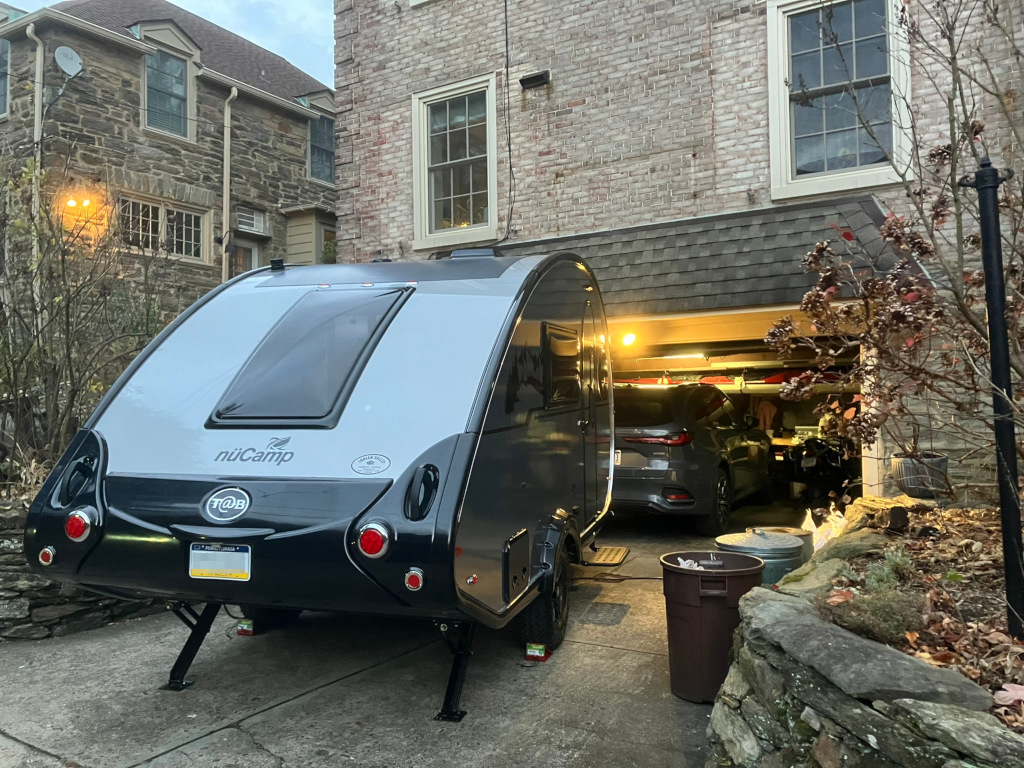
Our reservation was for Saturday night, but I couldn't wait: once we got the (not yet named) trailer home we rolled it into our driveway (which is 18' exactly), and I slept in it that night. This let me verify that everything worked, without the risk of hooking up and driving home if something didn't.
Check-in time for the park is 3 PM; sunset on November 30 is 4:36. We got on the road after lunch, to give us plenty of time to spare. We also took the Pennsylvania Turnpike, partly to get there faster, and partly so that I could verify that our EZ-Pass would be properly charged for the car + trailer (it was). The speed limit is 70, but for the most part I stayed in the right lane at 60. Surprisingly, I passed a couple of people; I never noticed just how slow the slow lane can be.
The other important learning from that drive was our mileage: 13.5 mpg. In retrospect, and with many more miles behind me, that was unnaturally low: a cold front was moving in, and I think we were pushing against a strong northwest wind. I now expect around 16 for interstates (driving at 62), and 17+ for secondary highways where the speed limit is 45–55. That's a significant drop from the Mazda's normal 28 mpg highway mileage, but isn't quite as bad as that original trip led me to believe.
When we got to the campground, the outside temperature was just above freezing, and the temperature inside the camper was 50 (per the Alde's thermostat). We set up, turned on the heat, and then I went for a walk around the campground while my wife bundled up with blankets and a cup of hot tea. It took several hours for the Alde to bring the camper up to 68. Later I learned that the air conditioner is also a heat pump; if we have an electric site and the outside temperature is 40+, it will make the interior comfortable much more quickly.
Which brings up another important point about this trip: we had a full hookup site. This allowed us to microwave our dinner, rather than cook from scratch after a potentially stressful drive and setup. With the forecast low temperatures, I decided to fill the fresh water tank rather than leave any hoses connected. In the morning, walking around the campground, I saw several people who hadn't, and had propane heaters pointed at their hoses.
The night passed uneventfully. The Alde did its job, although we realized that its thermostat is near the top of the cabin, and the air there is significantly warmer than at bed level. We keep our house cool, so that wasn't a problem, but it taught us to set the thermostat a few degrees higher than desired.
We got up, made coffee, and took a frosty walk around the campground. It was surprisingly full, including lots of people in tents (the coldest I've ever camped in a tent was low-30s; I don't think I'd leave my sleeping bag if the temperature dropped into the mid-20s). We went to brunch, and returned about an hour before checkout to drain the tanks and water system, preparatory to winterizing. And then, hooking up, I made my first big (expensive) mistake.
One of the selling points of the T@B trailers is that they're easily maneuvered by hand: there are grab handles on all four corners, and a wheel on the jack. That's a really nice feature when we want to put it in our narrow driveway. But it also made me lazy when hitching up: rather than positioning the ball under the coupler, I would back up to within a few inches, and then move the trailer into place (in my defense, I didn't know about the downward facing “hitch view” camera on my still-new car).
Some of you may see where this is going. For those that don't, the missing piece of information is that we had one wheel up on a leveling block. And when it came off the block, the trailer jumped forward and the leading edge of the coupler punched a hole in the bumper. Did I mention that the car was barely two months old at this point? I cursed my stupidity, and resolved to leave the hole in the bumper as a reminder not to do that again … but later discovered that it had also cut the wiring for the blind spot detector, which meant a two-week stay in the repair shop.
Other than that, we ranked our first trip as a success, and were looking forward to the next.
Storage
In the interim, where to keep her? Our neighborhood has a very suburban feel to it but it's still a city lot, 60' by 110', with a short, narrow driveway. The only place we can park the camper is in the street, and I didn't want it in the way of the city plows if we got snow. Fortunately, I had asked the salesman if he'd throw in winter storage, so Tabitha had a place to go for the next three months.
We visited her occasionaly over the winter, dropping off some of the things that we'd bought for future trips. The dealership is about 45 minutes away from our house, but close to my wife's uncle, so we'd combine visits. But it was too far to go on a regular basis: it would add friction to any trip.
My long-term plan was to get a 10x20 outdoor space in a storage facility about a half mile away from our house. I'd been looking at their prices, and it seemed that I could get a space for $80/month. But as March rolled around, they no longer had spaces available. No problem, with the threat of snow gone we could park on the street (and just worry about people speeding down our one-block street) and wait until spaces freed up. That happened, occasionally, through the spring and summer, but the prices remained over $100/month.
As November rolled around, the prices were bouncing between $88 and $104. I decided that it was better to pay a few dollars more per month rather than have a space that's 45 minutes away. So on a Saturday, with the price at $94/month if I prepaid four months, I signed up for a space.
I have to be honest: not having Tabitha parked outside our house worries me. Something might happen to her and we wouldn't find out about it until we're about to leave on a trip. However, since the facility is close, we can look in on her on a regular basis (and see her as we drive by, which we do several times a week).
There's also the question of security. The facility is in a decent neighborhood and has a high fence. We're parked away from the road, so the chance of vandalism is low. But there are a lot of people who have the gate code. I use a coupler lock, but that only stops casual thieves: someone who wants the trailer can defeat it pretty easily.
As a second line of defense, I attached an AirTag under the bed platform (so you need a square-drive screwdriver to get to it). My hope is that anyone who steals her will have an iPhone, and will get a warning that they're being tracked. With luck that will prompt them to drop her rather than search for the tag, and I'll be able to pick her up wherever they dropped her.
And then, two weeks after putting her in storage, I thought my fears had come true: the “Find My” app on my phone reported that she was nearly a mile away from the storage lot, in the parking lot of a supermarket. Just the place, I figured, where a thief would drop her to “cool down.” I got into my car and drove to the lot to check on her, and discovered she was still there. Blood pressure back to normal, but now I have less faith in the AirTag.
Changes in our family
Something else happened over the winter: we got a new bird. If you've read my earlier post, you
know that one of the factors driving our motorhome rental was a bird (Carly) who needed medicine
twice a day. Sadly, her medical issues caught up with her last fall; it was a very quiet winter
in our house.
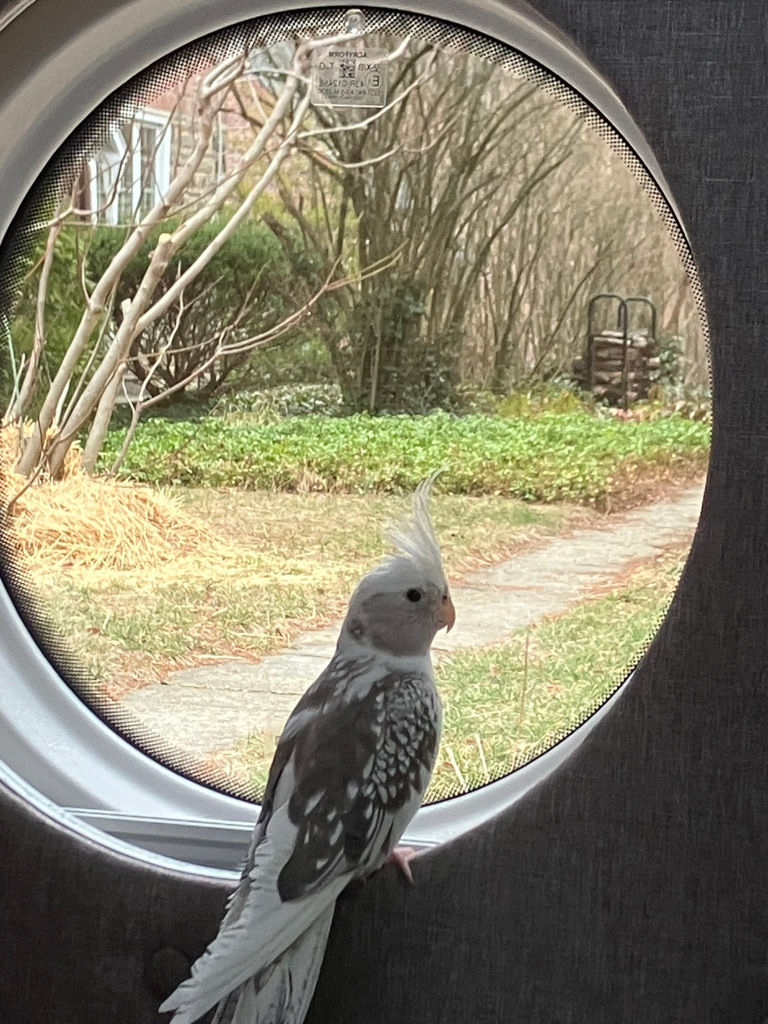
Unknown to both of us, my wife and I were occasionally looking at the website for the bird rescue where we'd adopted Carly. We each learned about the others' activity at dinner one night: “so, there's this bird named Ravioli…”
The big question: would Ravi like the trailer? She's a young bird, and does “zoomies” several times a day, flying around the room at high speed. How would she deal with being cooped up for travel days, and without room to zoom? As it turns out, she was fine: she can make short flights from one end of the trailer to the other, and she enjoys looking out the window.
Subsequent Trips
French Creek again
We returned to French Creek in the middle of March. This time, it was a site with no hookups, and, as it turned out, a sharp blind-side turn with a large tree about halfway down the driveway (this photo, made with the wide-angle lens of an iPhone, doesn't do it justice; there was literally one foot of clearance while backing in). The site was also shady, so we got to see how well the solar would recharge the battery: it was just below 60% when we woke up, but claimed to be fully charged before we left (foreshadowing!).
Returning home from this trip, I noticed that the brakes were very grabby. My habit is to let the engine do most of the work in slowing down (assuming I have room to do that, which I usually do), and lightly apply the brakes to bring the vehicle to a stop. While driving home that day, I could feel the drag from the trailer once I applied the brakes, and then a definite thunk! when I released at the end of the stop. When I got home, I saw that the brake controller sensitivity was set high (not sure how that happened). Turned it down to just below midway, drove around the neighborhood, and everything felt fine.
The Outer Banks
This was our first “big” trip: five nights in the middle of April. It was originally planned as four: two on Hatteras Island at a National Park campground, and two outside Kitty Hawk at a small commercial campground with full hookups. But my wife convinced me that my planned 400+ mile first day was a bad idea. Instead, we added a night at the southern end of the Delmarva Peninsula. That change opened up opportunities: instead of spending the entire day on a highway, we took the Cape May - Lewes ferry.
The ferry trip didn't reduce the length of the trip, but it did give us a nice break in the middle of the day. We picked up a to-go lunch from the restaurant at the ferry dock, and ate it sitting inside Tabitha. I was a little worried about driving onto the ferry — there's a warning about taking a trailer on the ramp at low or high tide — but it went very smoothly and we were positioned close to the front of the line so it was easy to get off. I was also worried about the trailer draining the car's battery during the voyage (I've already lived the embarrassment of a dead battery on a ferry), so disconnected the umbilical. As I later learned, it only receives power when the car's ignition is on.
The brakes continued to act up as we drove through small towns in Delaware; at one point I
heard the trailer's tires chirp while coming to a stop. They weren't dragging: whenever we
stopped for a break I felt the drums, and they were cool. I turned down both the sensitivity
and gain in the trailer controller, and looked to see if there was a nuCamp dealer along our
route. There was, but they didn't have time to look at the brakes, so I adapted my driving style
to avoid lockup, and went to our dealer to get them adjusted after the trip.

Our first night's stop was the Sun Outdoors campground in Cape Charles Virginia. This is a fairly large commercial campground, with large sites and tall trees for shade, but little screening from your neighbors. However, on a Thursday night in the middle of April it was all but empty. We went to Hook @ Harvey for dinner, a tiny restaurant near the Cape Charles harbor; expensive but excellent.
Since we had a full hookup site, the next morning I decided to try getting a shower in the wet bath. There was plenty of room, and the shower curtain kept the walls dry, but the camper wasn't perfectly level, so there was a puddle of water that remained in the bathroom when I was done, even after brushing water into the drain by hand (we bought a squeegee that day).
The drive that day featured two more “firsts”: our first lunch in a supermarket parking lot, and our first experience with pulling into a parking lot without having a clear place to park. Eating in a supermarket parking lot is one of the great reasons to own a small camper: it eliminates the stress of finding a place for lunch. Pulling into a lot without planning, not so much.
It happened at Front Porch Cafe in Kill Devil Hills NC (also recommended; they have great coffee). It's in a strip mall, with
a fairly large parking lot that wasn't that full. But there weren't any consecutive empty spaces,
so we had no place to park and no place to turn around without unhitching and turning Tabitha
by hand. I was originally planning to park on the street nearby, but those streets are very
narrow, and while not marked with No Parking signs, I don't think we could have parked without
blocking traffic. As it turned out, the parking lot extended around the back of the building,
and we were able to find space there. Much better than backing out, but a reminder to always
look at the Google Maps “satellite view” first!

We spent the next two nights at Frisco Campground, a National Park campground on Hatteras Island (not the Frisco Woods Campground, which is a commercial campground in the same general area). This campground has running water, bathhouses with flush toilets, and cold (!) showers, but no dump station. Our site, F-10, was fairly small and not particularly level. But it was nestled in the sand dunes, which gave a sense of privacy and also blocked the constant wind (I suspect that might make it a mosquito haven during the summer). And it was a five minute walk to the beach, which was all but empty when we were there (according to reviews, it gets crowded with off-road vehicles in the summer).
This was our first multi-day dry camping experience, albeit only for two days. We had a full tank of fresh water that we'd brought from Philadelphia, and I'd emptied the gray at Sun Outdoors (although not completely, I think), but the black tank already had two days of usage. We ate dinner and breakfast at the site both days, with associated dishwashing, but didn't take any showers (I used the campground shower, which was a bracing experience). When we left, the black and gray were both showing 2/3 full, and the fresh was — possibly due to an uneven surface — showing only 1/3. Fortunately, our next stop was a full-hookup site at OBX Campground, a small commercial campground just outside Kitty Hawk.
The rest of the trip went smoothly: we went to the Wright Brothers National Memorial, and the Fort Raleigh National Historic Site, but didn't go to the beach in Kitty Hawk. On the drive home, we stopped at Chatham Vineyards on the Delmarva Peninsula for lunch, sitting on their covered patio while a light shower moved through, eating our lunch and drinking a flight of wine. Maybe that's not an “RV-only” experience, but I think if we'd just been driving our car we would have gone to a restaurant for lunch.
Approaching Wilmington Delaware at rush hour, we stopped at Cabela's for an impromptu break. This store provides overnight RV parking, although it's right next to the highway so I don't think I'd want to stay there except in an emergency. After shopping and eating a light dinner of whatever was left in the fridge, we headed out to do battle with the I-95 traffic. It wasn't that bad (although still fast and heavy), and we arrived home at 8 PM.
A very successful trip.
New England
We took two more trips that spring: two nights dry-camping at
Shawnee State Park in south-central Pennsylvania, and two nights at
Dingman's Campground in the
Delaware Water Gap, with electric and water hookups. That electrical hookup was extremely welcome:
the weather in eastern Pennsylvania in late June is generally hot and humid, with frequent
thunderstorms. It was our first time really using the air conditioner, and it did a great job
at keeping the camper cool and dry.
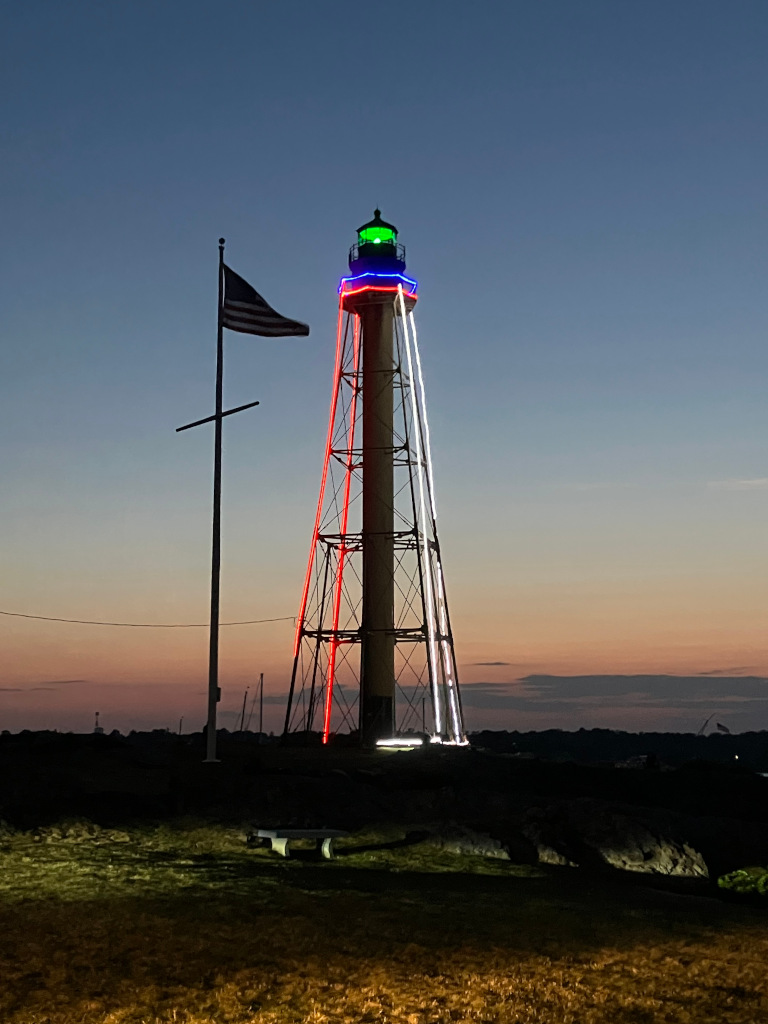
But those trips were preludes: for our summer vacation, we planned a ten-night trip through New England. The first night, July 3rd, was a return to Dingman's campground: we had originally planned to leave after work, so wanted a minimal drive. As it turned out, we took the entire day off, so had a leisurely departure. For the fourth of July weekend, we planned to camp in our niece's driveway in Marblehead Massachusetts. Then on to four nights at Acadia National Park in Maine, followed by two on on the northern edge of the White Mountains. Finally, one night outside of Woodstock New York to break up the drive home. An ambitious trip, most of it dry-camping, and nearly 1,500 miles of towing on a wide variety of roads. What could go wrong?
At least at the beginning, absolutely nothing. We arrived at Dingman's in the middle of a severe thunderstorm warning, but the rain held off until after we set up. The next day was bright and sunny, we got an early start, and made a stop at the CAT Scale in Newburgh NY to check our weight (more below). We remained on Interstate for the entire day, and the traffic was generally light: we maintained 60 or so, and got 16 mpg for the day. Even the normally busy areas moved smoothly.
We spent the weekend catching up with friends and family, eating well, and enjoying time outdoors. On Monday morning the outdoors became less enjoyable, as heat and humidity moved in. But that was OK, because we were on our way to Maine, and the forecast temperatures there were much lower than eastern Massachusetts. On our way to I-95, we made a stop at Richardson's ice cream, hoping to score a quart of their Frozen Pudding (a flavor your can only get in New England). They didn't have any (did I mention it's an “old fart flavor”?), so we “settled” for Mocha Chip (also excellent, and something that you can have without specifically being in the mood for it).
The temperature remained in the low 90s until we “turned the corner” into mid-coast Maine, and the southerly wind was cooled by open water. We stopped for lunch at a small park just east of Bath (after being unable to find parking in Bath), and continued up Route 1.
We arrived in Rockland around 3 PM, our normal time for an afternoon coffee break. I remember Rockland as being a little run-down, but that was 20+ years ago. It now has a thriving downtown, with lots of small shops and restaurants. We found excellent coffee and a gluten-free crumb cake at the Atlantic Baking Company. We also found consecutive on-street parking spots, giving us plenty of room for car and trailer. I suspect that was only because we drove through on Monday, and it would be hard to find even a single spot on a summer weekend.
We arrived at Blackwoods Campground in Acadia National Park around 6 PM, made a stop at the dump station, and then went to find site A-65. This is a long, narrow, back-in site that sits at an acute angle to the road. I failed twice at backing in, then realized that I had to pull well past the site and then barely turn the trailer. Trees on either side of the driveway caused me some worry, but with my wife on the walkie-talkie giving guidance, it all worked out.
The site is also very shady, and the skies were overcast, and that led to our first major issue of the trip: the solar panels didn't provide enough power to recharge the battery. I realized this at lunchtime of our second day: the Victron app said that the panels had only produced 50 watt-hours of power so far that day, and the battery was down to 30%. I had become complacent about the ability of 600 watts of solar capacity being able to overcome a shady site. But shade and clouds were too much.
When dry camping, being able to recharge your battery is critical: without it, you lose your refrigerator and lights, and more importantly the water pump. We immediately shut off the fridge, then drove into Bar Harbor and bought a cooler and ice. And we ate the quart of Mocha Chip ice cream as a mid-afternoon snack. But that wasn't enough, and at some point in the night the battery shut itself off.
The next day was sunny, so I tried repositioning the trailer on the site, but that didn't raise the solar output by much. We had to dump our gray tank (I'd taken a shower the previous day), and when I saw that the panels were producing over 400 watts at the (unshaded) dump station, I decided that we should eat lunch in the (unshaded) overflow parking area. That was great, until the clouds moved back in; still, we managed to eke out 350 watt-hours that day. I was hopeful that it would carry us through.
I also plugged the trailer into the car, using it as a (quiet) generator. That gave us power to
clean up dinner dishes and run the LED lighting, but wasn't a viable way to recharge the battery:
the trailer only draws 8 amps through the connection, so I'd need to run the car for 12 hours for
a full charge.
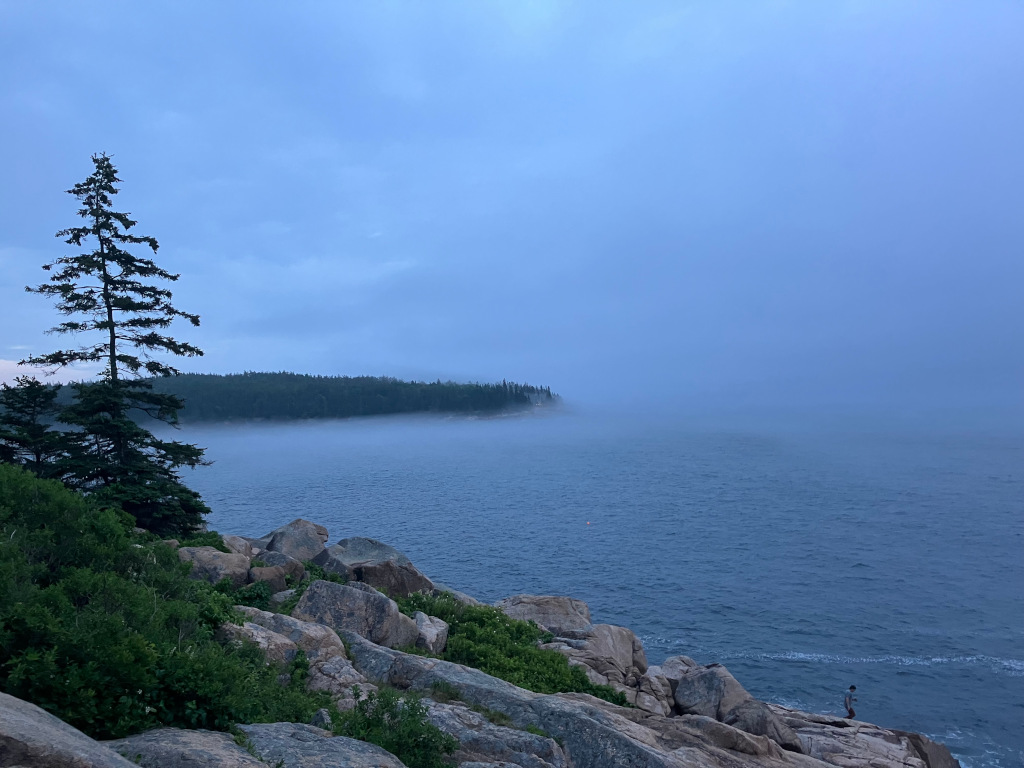
Thursday was another overcast day. We crossed our fingers that we'd have enough power in the battery to last until we broke camp the next day, and went about the business of enjoying Mount Desert Island and Acadia National Park. And there's a lot to enjoy: we did several short hikes, and I did a bicycle ride along the Loop Road (which is surprisingly hilly: from Blackwoods to Jordan Pond, and back via ME-3 featured 900+ feet of climbing in ten miles). We didn't see the sunrise from the top of Cadillac Mountain (in July, you have to wake up at 4 AM to do that … assuming you're able to get tickets), but we did see the full moon rise from the rocks just outside the campground.
The battery shut itself down again on Thursday night. I woke up in the middle of the night to use the bathroom, and realized that it was unnaturally dark inside the camper: usually there's a faint glow from several “indicator” LEDs and the Alde control panel. Oh well, nothing to do about it, and we were going to pack up and head out in the morning. If the day was sunny, we'd recharge the battery via solar; if not, our next campground had full hookups.
Our original plan was to spend two nights visiting a friend in southern Vermont, then return home on Sunday the 13th. But it turned out that he was also on vacation, so we revised our plans to spend two nights in northern New Hampshire. Along the River is a nice, small, family-owned campground in Twin Mountain. We had site #1, at the far corner, which is fairly large and screened from the neighboring site (there's also an open field area for large RVs with less privacy; if you go there, pick your site accordingly). And they have a pool, which was a welcome sight at the end of a hot and humid day.
We had a torrential downpour that first night, but woke up to a sunny morning. We had talked
about taking the Cog Railway to the top of Mount Washington, and decided that we'd let fate
decide: we'd stop by the ticket office and if tickets were available for the next train, we'd
do it. Fate smiled on us, we got tickets, and we rode to the top of the mountain 12 years and
364 days after hiking up it. It's an expensive experience, but one that's worth doing at least
once, as is the Auto Road on the other side of the mountain. Unfortunately, clouds rolled in
soon after we got to the top, so the view disappeared; a risk of being in the place with
“America's worst weather.”

Those clouds brought rain with them, which hit as we were driving through Crawford Notch. It wasn't heavy rain, but it quelled any thoughts we might have had of an ad hoc hike. Instead, we went to Conway NH for lunch, and I learned that there is now more than one traffic light in Conway but the traffic was just as bad as always (New England skiers know what I mean). After lunch we stopped at a supermarket to restock supplies, and drove over the Kancamagus Highway. There were off and on showers, which I think kept most other people off the road, but that was OK: it's still a beautiful drive. We stopped for ice cream in Woodstock (NH), and then headed back to the campground.
By this point I was ready to be home (and you, dear reader, may be feeling the same way). But it's a 450+ mile drive from the northern White Mountains to our home. So instead we had one more night to break up the trip, at Kenneth L Wilson State Park near Woodstock NY.
We kept to secondary highways, cutting through central Vermont, and were rewarded with great scenery. We made a stop for a hike at Quechee Gorge, and lunch in Woodstock (VT; there were a lot of Woodstocks on this trip). For a touristy town, Woodstock has surprisingly few options for lunch. Instead, we parked at the town common and had sandwiches in the camper.
We didn't arrive at the campground until after 6. I had been looking forward to going to dinner (Woodstock NY has lots of restaurants), but by that point we were both feeling tired. Instead we took a walk around the campground and ate a light dinner from what was left in the fridge.
The dewpoint that night was well into the oppressive range, and the site didn't have an electrical hookup (many, if not most NY state park campgrounds don't!). I switched the roof fan to blow inward, just to feel air moving, but it was still an uncomfortable night. The next morning at the bathhouse, we met a woman who was traveling in a class B with her dog, looking for some place in New England that wasn't humid. Hopefully she found a campground with an electric hookup, because a dome of warm and humid air was firmly over all of the northeast and not forecast to move any time soon.
Our morning drive took us through the Catskills, and around the Pepacton Reservoir (one of the sources of the Delaware River). We stopped for lunch in Hancock NY, where we had a conversation with an elderly brother and sister who were originally from the area but now lived in Florida; they were in town to visit family. He was a former FAA inspector, so we talked about flying as well as the town. I find these types of conversations happen a lot when you eat at restaurants in small towns, and never when you eat at a highway chain.
We arrived at Honesdale PA around 3 PM and stopped for coffee. Afterward, my wife took over the driving, just as heavy rain started. We switched back in Stroudsburg PA, because there is a tricky intersection there and I (thought I) knew the correct way to get through it. Just after we switched the skies opened up, I went through that intersection in the wrong lane and we found ourselves on I-80 headed eastbound, with the Mazda flashing warnings that its front collision avoidance system was inoperative due to the heavy rain. I got off at the Delaware Water Gap exit; at that point the rain was so heavy that I could barely make out the edge of the exit ramp. We stopped at the visitor center just off the highway to wait for the rain to abate.
From there, it should have taken around two hours to get home on PA-611. But instead it took three, with off-and-on torrential downpours, and one long stretch behind a Walmart tractor-trailer that should not have been on such a winding road. We pulled up in front of our house at 8, dodged raindrops to unload the important stuff, and put off the rest for the next day.
The Rest of the Year
I'm not going to bore you with details of our subsequent camping trips. We got out once or twice a month through the rest of the summer and fall, wrapping up with another post-Thanksgiving “winterization” trip, this time to Lums Pond State Park in Delaware.
Most of those trips were for three-day weekends, and this becamse another important lesson: it isn't much fun to spend most of a day driving to a campground, only to set up, sleep, and spend the next day driving home. To make a trip enjoyable, you need at least a day at the destination. And since we don't have unlimited vacation time, that meant three day weekends.
It also meant that our destinations were relatively close to home, typically within 250 miles. While the Pennsylvania Turnpike will let me drive 70 miles an hour, gas mileage (and safety) incent me to drive slower. And tolls incent me to stay off the Turnpike entirely. So we typically drive on secondary highways, with short stretches on interstate to avoid cities or long diversions.
This also gives us a much better sense of our surroundings; they don't just zip by the windows.
And it lets us stop at interesting places along the way, ranging from actual tourist destinations
to interesting restaurants for lunch or a mid-afternoon coffee break. In my opinion it's a more
civilized way to travel. But it doesn't make for high mileage.

Which is OK: there are plenty of destinations within a 250 mile radius of our house. One that I will call out, because we agree that it's our favorite campsite, is Fifteenmile Creek Campground in western Maryland. This is a ten-site primitive campground, adjacent to the Potomac River, C&O Canal Traiil, and Western Maryland Rail Trail. The sites are well-spaced but their driveways are small: we had to park the car crosswise in front of the trailer. The only source of water is a hand pump that requires a lot of effort for very little result. And you have two choices of how to get there: the main road, which passes under a low stone bridge, or a winding road that at times is only 1.5 lanes wide (for what it's worth, the bridge provides at least nine feet clearance; Tabitha can fit through with no problem). All of these attributes keep people away: when we went there in September, only three other sites were occupied.
Modifications
We've added four things to Tabitha. The first was another propane tank, added while she was in winter storage. I was worried about running out of propane on a shoulder-season trip, and had the idea that I could take the second tank out of the cargo box to feed our propane campstove.
In retrospect, this was a mistake. The Alde doesn't use that much propane — our first
tank lasted almost the whole year — and I discovered that the top of the front tub makes
a great place to put the campstove when cooking. The Mopeka sensor that came with the trailer
seems to do a good job at reporting how much propane is available. And in reality, there will
be a propane filling station close to wherever we might go camping.
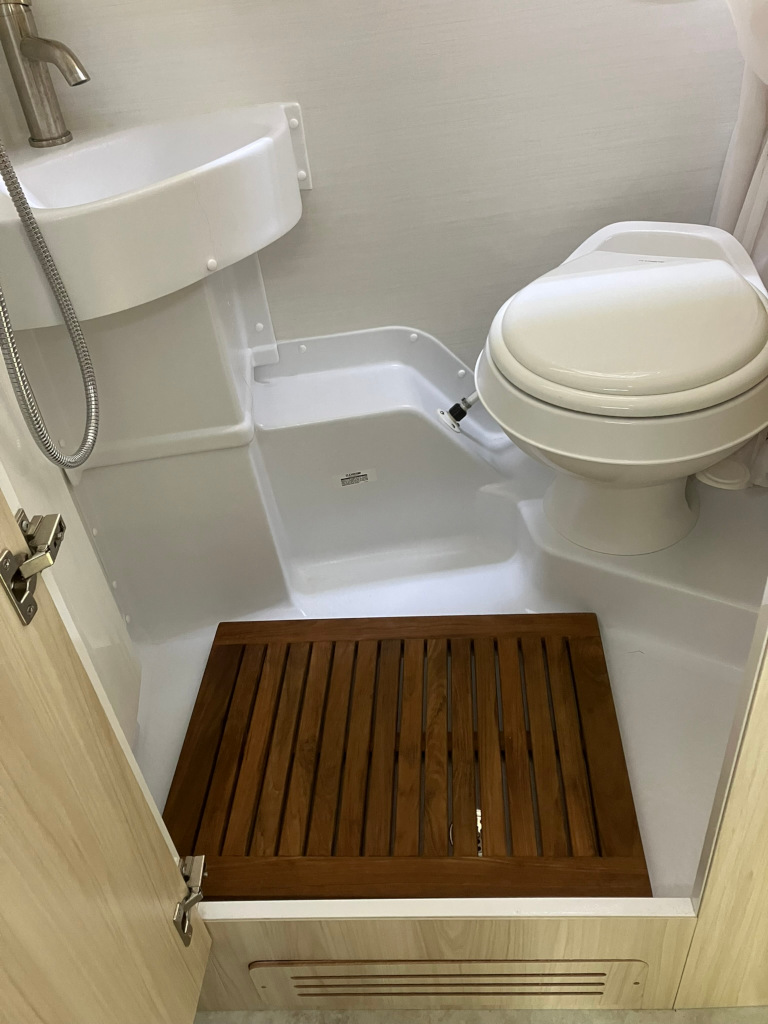
The second mod was much more successful: a teak insert for the bathroom. One thing that I learned after my first shower was that there's always a puddle left behind, which makes subsequent visits to the bathroom unpleasant (especially in sock feet). For that matter, the fiberglass bathroom floor doesn't feel great even when dry.
We got a generic 30x20 shower mat. There is a (much more expensive) insert that fits the T@B bathroom exactly, and it might be in our future: I'm worried about the rectangular mat bouncing around the bathroom while we're driving, potentially putting a hole in the wall. One big benefit of the rectangle, however, is that we take it out of the bathroom while taking a shower and put it in the center aisle. This gives us a nice place to stand while drying off, and it keeps the insert dry for when we put it back in the bathroom.
At about the same time, we bought a Jack-It bicycle rack. We both enjoy bicycling, and looked forward to riding the Acadia carriage roads. And our dealer had a floor model available at a significant discount.
The jury is still out on whether this was a good purchase. We've taken our bicycles on several trips, but ride them less than expected. Partly, that's because we always find so much else to do.
But it's also because going for a ride anywhere but the campground requires first riding
to and from wherever it is that you want to ride. For example, I wanted to ride the Acadia
carriage roads, but that meant first riding the Loop Road to Jordan Pond, and then back
via the public highway (at the time I didn't realize that I could take the Loop Road bus,
but the lines get long at Jordan Pond, so it might not have been an option for the return
anyway).
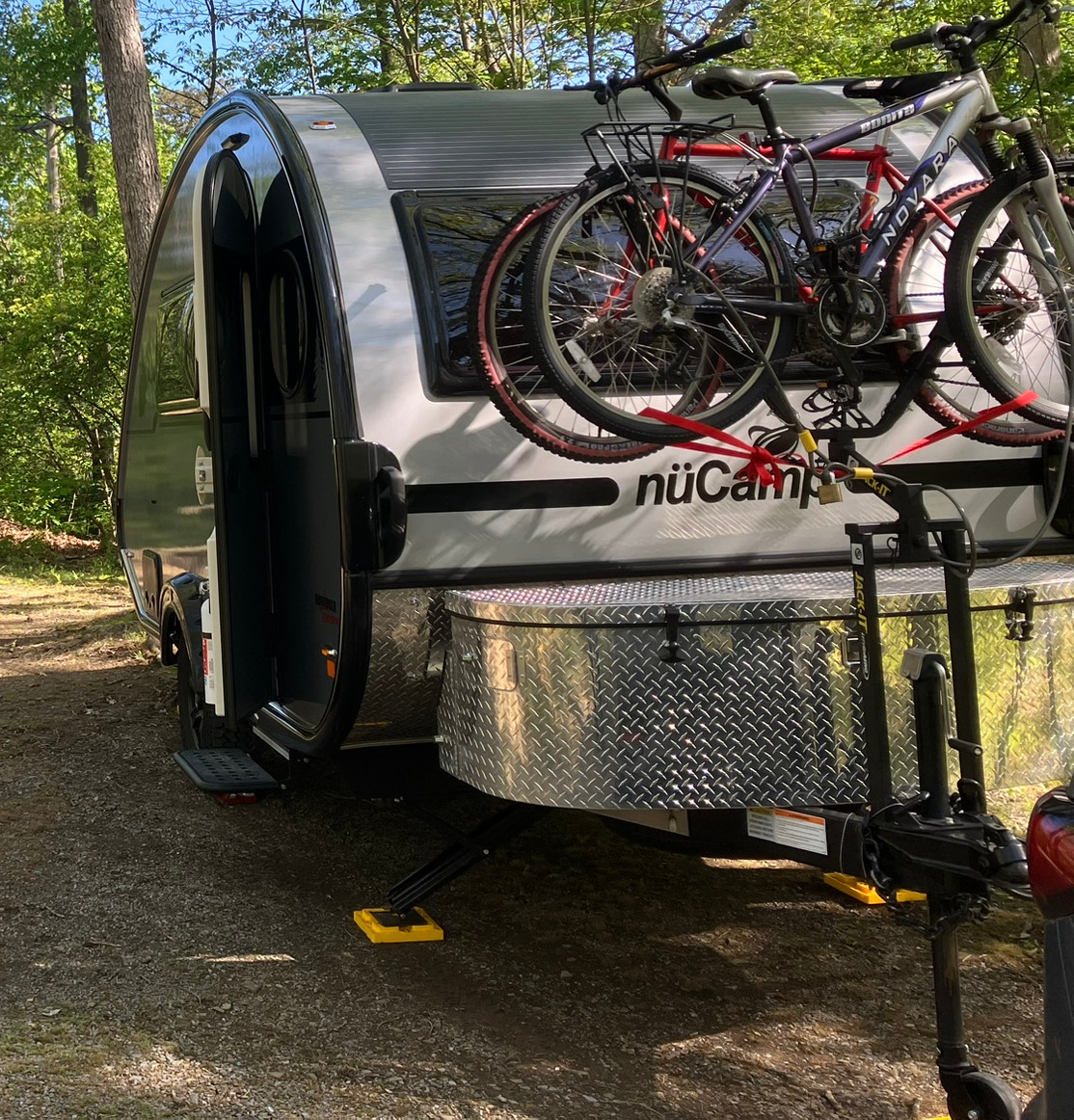
There is an adapter for the Jack-It — the Bump-It — that lets you attach the rack to your receiver. However, I had trouble finding one: none of the resellers that I asked knew about it, and it wasn't even on the manufacturer's website until the end of the summer. And buying it there meant clicking through an agreement that held them blameless for any problems with the rack, including whether or not it would even fit on my car.
One other issue — a big issue — is that the rack is about as close to the trailer hitch as you can get, meaning that its weight and the weight of the bicycles directly add to the trailer's tongue weight. Maybe not a problem if you're driving a half-ton pickup with a class 4 hitch, but a concern for us with our class 3 and its 500 pound tongue weight limit. If we take the bicycles, we can't take anything else (like a spare propane cylinder) that would increase tongue weight.
And lastly, bicycle rentals are a thing, and aren't (generally) big money. At Acadia, for example, you can rent bicycles in Bar Harbor and take them on the Island Explorer bus to and from the carriage roads.
The last mod (so far) was a second battery. This proved its worth one overcast weekend, where the solar panels again couldn't keep up with the load. By Sunday morning the SmartShunt showed that we'd consumed 104 amp-hours. If we'd just had one battery, it would have shut itself off; with the second, we still had another 96 amp-hours to go.
The second battery is a BattleBorn BB10012H, the same model that came with the trailer. It was $900, even on sale, so was a decision that I pondered right up to the point that we ran out of power at Acadia. I called BattleBorn, discussed out situation with a technical rep, and ordered that day.
Installation was straightforward: the T@B 400 has space for four batteries (there's a factory-installed option for that, along with a 3,000 watt inverter that powers all of the outlets). The one tricky part was fitting the cables that connect the two batteries: I bought twelve inch premade cables along with the battery, and they were just a bit too long for the space. I was able to bend them to fit, but an 18 inch or even 9 inch cable would be a better choice. I also had to screw a piece of plywood into the bottom of the battery compartment to hold the battery in place (the factory-installed battery has an aluminum angle bracket for this, a possible future upgrade for me).
Ultimately, the second battery only delays the inevitable. A succession of cloudy days will drain both of them. But with the extra capacity I can plan with a time horizon of days rather than hours, so hopefully we won't need to buy another cooler in the middle of a trip.
And finally, full disclosure: after installing the second battery I bought stock in Dragonfly Energy, BattleBorn's parent company.
Visiting the Scales
You may have detected I have concerns about weight, especially tongue weight. The specs for the 2025 Black Canyon are a 3,900 pound maximum weight (GAWR), 2,946 pound gross dry weight (that is, without anything in the tanks), and a 380 pound tongue weight (also dry). These are all well within the capacity of the Mazda. But Keep Your Daydream convinced me that I should take a trip to the scales.
There's a CAT Scale not too far away from French Creek, so we went there on the way to our second overnight. My main interest was seeing how a full tank of water affected the weight, so I got there with a full tank, and planned to take a second weight with the tank empty. That didn't quite work out: after sitting in the parking lot for 45 minutes with the low-point drain open, the tank still hadn't completely drained. But we did get two weights with the full tank, and they indicated a tongue weight over 700 pounds!
That certainly worried me, but there was little that I could do about it at that point. Given that later weights were nowhere near this, I think that what happened was that I wasn't on the scale properly. A CAT scale is designed for a tractor-trailer, and it has three pads: one for the front (“steer”) wheels of the tractor, one for the back (“drive”) wheels of the tractor, and one for the trailer wheels. For this first weighing, I tried to follow that, but the Mazda + T@B aren't long enough to make this work: my front wheels were at back the edge of the first pad, and the trailer wheels were at the front edge of the third. Depending on how the scales work, that could affect the reported weight. For subsequent weighings, I used a process where I first put the entire car on pad 2 and the trailer on pad 3, then pull forward so that the car's front wheels are on pad 1 and the rear wheels and trailer are on pad 2.
As I said, subsequent weighings. The next weekend I went to a truck stop a half hour away from my house, and did a second weighing. This came in much better, at 420 pounds tongue weight and 3300 pounds trailer weight without the bicycles. That tongue weight was higher than I'd like, at nearly 13% of trailer weight, so when I got home I moved items such as my toolbox from the front of the trailer into the back storage compartment. I also realized that I wouldn't be able to take bicycles and a second propane cylinder; it would be one or the other.
We made a third attempt at weighing before our big trip, with the same load that we expected for that trip (full water, bicycles, and all of our cycling and paddling gear). I say “attempt” because we didn't actually get weights. I was on the scale, using the app, when it suddenly said “scale is busy see weighmaster.” I did that, and learned that she thought that I didn't know about the call button, so had taken the weight manually. With that cleared up I went back around to the scale, only to discover that it was occupied by a tractor-trailer with frozen brakes. After a few minutes, and seeing the truck behind me abandon the scale, I did so as well.
Our last weighing (to-date) was at the CAT Scale in Newburgh NY during out summer trip, with full vacation gear. This gave us a 3,500 pound trailer weight and a 480 pound tongue weight. Still a little high for my taste, meaning that we can't add anything to the front box, but within rated capacity.
I should probably weigh again with the new battery: it's behind the axle, so will reduce tongue weight. However, given that it's only 30 pounds, and isn't that far behind the axle, it's only likely to reduce the tongue weight by a few pounds.
Understanding the Electrical System
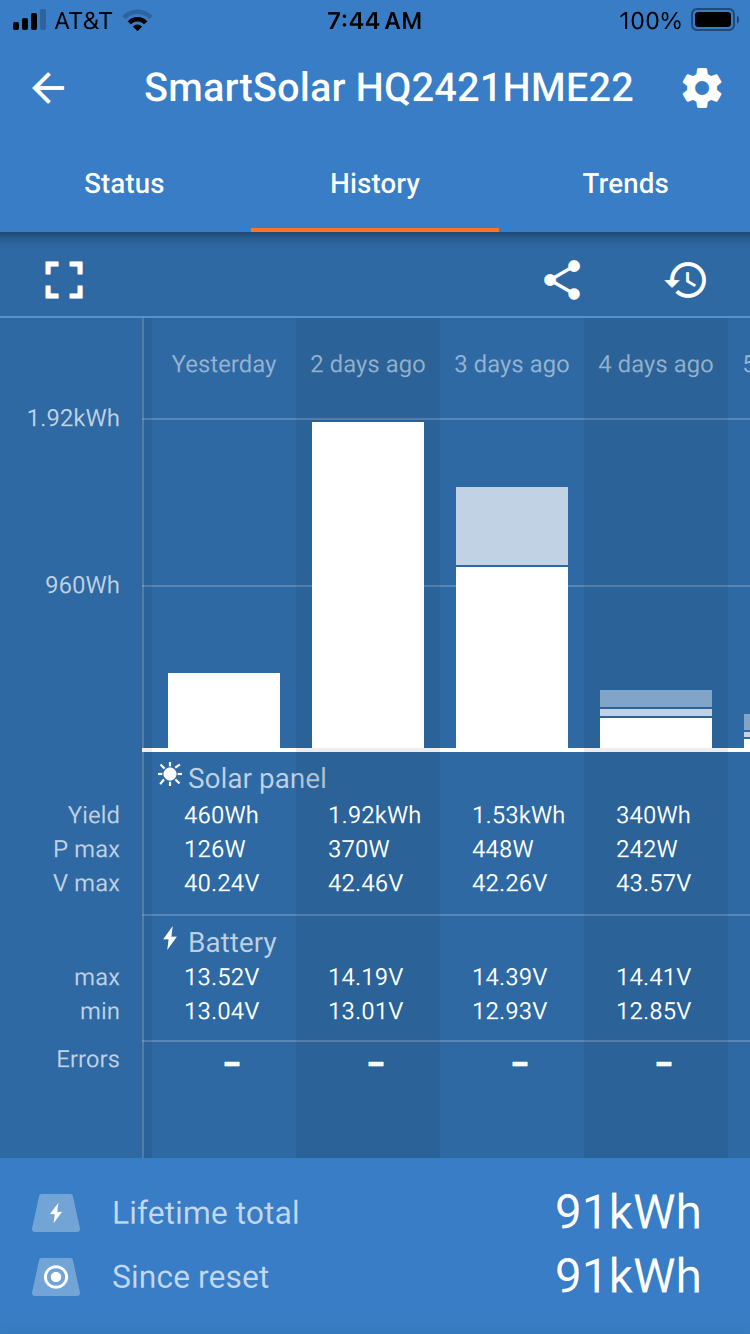
I didn't pay much attention to how the 12-volt system worked for the first seven months we owned Tabitha. It did its thing, and the Victron app typically said we were back to full battery by mid-day; that was enough for me. Then we ran the battery down to the point where it shut itself off. That made me wonder exactly how the system worked, and as a result I actually read the documentation to understand what the Victron app was telling me.
And the first thing that I learned was that the SmartShunt is a passive device: it simply reports how much power is going into or out of the battery, and estimates how much you have left. If it says that the battery is at 99%, that simply means that it's measured almost as much current coming back it as it measured going out. I say 99% because it will recalibrate to 100% when you reach a preset voltage level — which may not be set correctly (mine was set for a lead-acid battery, not lithium, and the “100%” voltage was too low).
Second, I learned about the three-stage charging process — bulk, absorption, and float — and that if the system didn't switch to float mode at some point during the day, your panels were not keeping up with the load. Even if the SmartShunt told you the battery was at 100%.
My understanding of how the charge controller works is that it always attempts to supply a fixed voltage. However, during the bulk phase it doesn't attempt to restrict amperage, and by Ohm's law (power equals amperage times voltage), a high current draw will cause the voltage to drop. As the battery charges, it demands less amperage, and the voltage will rise. When voltage reaches the preset “absorption” level, the charge controller switches to absorption mode and stays at a fixed voltage for a short time (one hour by default) to “top off” the batteries. Then it switches to float mode, where it provides a lower voltage to keep the battery charged.
This is important, because I saw several cases where the charger switched to absorption and then float stage while the battery voltage was still well below the target absorption voltage. I couldn't understand this, until one day I was looking at the Victron app and saw a significant difference between the voltage reported by the SmartShunt and that reported by the charge controller.
I think the cause of this divergence is that, by default, the charge controller measures voltage at its output, while the SmartShunt measures voltage at the battery. That means (I think, based on high school electronics class from 45 years ago) that the SmartShunt sees voltage drops from the loads in-between those points.
The solution was to tell the charge controller to use the SmartShunt's voltage, by setting up a “VE.Smart” network. This is something that's worth checking if you also use Victron products in your RV.
So how much power do the panels produce?
The T@B400 Black Canyon has 600 watts of solar capacity. However, I don't ever see that much power coming from the panels. For one thing, they're wrapped around the teardrop, so don't receive equal sunlight. For another, I live at approximately 40 degrees of latitude, so the sun is always at an angle, never directly overhead. And if the camper is parked obliquely to the path the sun takes, or is shaded, that cuts the power even more.
I tried an experiment to see how much power the panels might produce: at noontime on a sunny day, with the camper aligned to the path of the sun, I plugged my 1,000 watt halogen work light into an outlet powered by the inverter. According to the Victron app, the panels supplied around 450 watts. Which I thought was pretty good, given the caveats above.
I also started down the rabbit hole of trying to figure out the loads on the 12 volt system, but quickly decided that was a fool's errand. The problem is that they'll change: the refrigerator, for example, works more on a hot day, and we'll also be running the fan on such days, to keep the inside cool. Throw in a laptop or two, and maybe watching TV, and the total load is completely unpredictable.
Instead, I downloaded stats from the charge controller over the course of the summer, and learned that the median daily output was around 750 watt-hours. This includes days when we were camping, days when Tabitha was sitting in front of our house running the fridge (it's my beer fridge), days where the fridge was shut off to defrost, days with full sun, and days with rain and clouds. The median, hopefully, ignores the extremes and gives me a relatively accurate sense of what a “typical day” looks like.
And at 750 watt-hours, it means we should get three days out of the batteries before needing to buy another cooler. As I said, the second battery only delays the inevitable. But I now know how to interpret what the Victron app is telling me, and can hopefully take remedial action (such as taking the trailer to a sunny parking space, or even moving to a campground with electrical hookup) before that happens.
Things I'd Like to Change
After a year, there aren't many things that I'd like to change.
The coupler is one: it's a “yoke” coupler, and can be extremely difficult to latch and unlatch. This is actually the second coupler on our trailer: the first was replaced under warranty because it wouldn't correctly latch (so that the retaining pin could be slid into place) no matter what I tried. I've seen videos where other people have similar issues with the same coupler, so I don't think it's just me.
I have learned one trick to make it work: chock the wheels and then pull the car forward a fraction of an inch, so that the ball presses up against the forward edge of the coupler. That lets the yoke engage or disengage freely.
The other thing that I'd like to change is the gray tank. The specs say that it's 18 gallons, up from 15 in 2024. It's still not enough: it fills up after two or three days, even without taking a shower. I saw that the black tank capacity also increased for 2025, and wish that increase had instead been given to the gray.
Wrapping Up
My wife and I are “ad hoc” vacationers: we like to go somewhere and explore on our own, making plans for each day as it comes (as opposed to what I'll call “programmatic” vacations like a cruise, theme park, or package tour). And for that type of vacationing, Tabitha is perfect: we pick a location and find a campground nearby. We don't have to worry about finding bird-friendly accommodations, and we can easily extend our stay if we desire. And if we decide we're not that interested in the location, we can move on without forfeiting a lot of money (at least when staying in state or national park campgrounds). We also don't have to stress about finding places to eat: if we don't see anything when we start to feel hungry, we just park and make our own.
What really surprised me was just how much more we traveled this year. In the past, we'd discuss a vacation weeks in advance. Having Tabitha parked in front of our house, ready to go with a few hours prep, has us idly discussing a trip on Tuesday and being on the road Friday.
For now, Tabitha is the right size for us, and for the trips we take. We are talking about a cross-country trip when we retire, and I think we may want a bigger trailer for that (mostly to have a dry bath). But that's several years down the road, and a lot might change between now and then.
Copyright © Keith D Gregory, all rights reserved